1. charges by bouncing piezoelelctrically
2. has a bubble memory, or spherically arranged memory and switch/computing architecture embedded in metallopolymer mass of the ball, changing resiliency/elasticity
for translational and 3D awareness, to reverse bouncing back to the starting point.
Showing posts with label My Inventions. Show all posts
Showing posts with label My Inventions. Show all posts
Tuesday, March 17, 2020


Monday, November 18, 2013
High tech dental:
Elimination of large x-ray machines by using a grooved ball slid over a tooth to get a CAd-scan
something like this

miniaturized devices for radiating x-rays, ultrasound, heat and other electromagnetic spectra, and
sensors for he absorption of the radiation,
and onboard or separate pluggable processor unit for determining absorption of the radiation, and imaging on a display
Wednesday, November 13, 2013
High-Tech pen ideas:
mechanical-fluid twist-controlled mechanism
onboard microcomputer elelemnt conformal to the body of the pen
Light powered lumiactive battery conformal to the body of the pen
Non-strip threads
metal-lattice polymer sleeve with elastic memory for adapting to the owner's grip
ink delivery in alternate ball-point/fountain pen modes
signalling:
Signature/writing memory and verification of user
Replace Cap alarm beep
New user (writing detection) alarm/beep
Illumination assist glow light
Thursday, April 25, 2013
The Eco-Friendly, Green and Compact Nuclear Reactor
I have had this idea for several years, and now realize that I have neither energy, time nor money for the Patent Cooperation Treaty application that is a must to patent this idea. I have chosen to disclose the invention right here and at this moment, to at least have some claim to the priority date of the invention.
The System is a portable and compact turbo reactor power generating system comprises an integral turbo reactor - steam turbine coaxial assembly (the turbo reactor and the turbine in the drawing), charged with deuterium oxide containing coolant, and a conventional electrical generator detachably connected to the turbine of the turbo reactor assembly by a conventional direct or geared drive.
The System is a portable and compact turbo reactor power generating system comprises an integral turbo reactor - steam turbine coaxial assembly (the turbo reactor and the turbine in the drawing), charged with deuterium oxide containing coolant, and a conventional electrical generator detachably connected to the turbine of the turbo reactor assembly by a conventional direct or geared drive.

Simplifying the reactor
design eliminates the need for separate and oversize reactor, a steam turbine,
a primary and secondary steam pipework, multitude of pumps, control systems,
and extensive cooling systems, complicated connections, and emergency power supply.
The turbo reactor design allows for a highly efficient and safe energy output while
occupying a minimal space and being very easy to manufacture and assemble, and transport.
The turbo reactor assembly can
be easily miniaturized to dimensions that allow the reactor assembly to be
easily transported by railroad, quickly connected to the electrical generator, all
the while capable of producing the same amount of electrical energy as a reactor
unit of standard water-cooled nuclear reactor power plant.
The important advantage of
the system is that the rod control supplemented by the use of the deuterium
oxide guarantees an assured safe shutdown without the need for any emergency
power supply. The fuel used in the rods also offers a security advantage by
precluding its potential enrichment for manufacturing nuclear weapons.
The Turbo Reactor
The turbo reactor part of the
assembly is an equivalent of a conventional compressor turbine, except the heating of the coolant directly and immediately drives the turbine, and contains
fuel rods. The rods are designed to protrude into the turbo reactor compression cavity
through fluid-tight openings that also ensure the rods sliding inwardly-outwardly along their
axes.
The rods, when inserted into
the reactor section to an optimal depth, heat the coolant, which could be deuterium oxide containing fluid,
vaporizing it and causing it under pressure that would act on the turbine
rotors, thereby producing rotation energy to be transmitted directly to the
electrical generator. The resultant heating is self-sustained, is easily controlled by the the insertion depth of the rods, or a valve, and requires no pumping.
The rods are similar in physical
or nucleo-chemical design to the rods used in fuel clusters of the Canadian
Deuterium (CANDU) reactors. The reactor containment vessel can be substantially
similar to a casing of a conventional steam turbine, preferable manufactured of
high-tensile metal.
The Rods
The rods are designed and
engineered to be of optimal physical dimensions, of nuclear material and
concentration thereof so as to ensure nearly critical reaction that results in
production of heat, and when required, quickly stops the production of heat
when moderated with the deuterium oxide containing coolant. It is envisioned
that the rod dimensions could be of 1-6 cm in diameter, and 10-100 cm length.
The shape of a rod and the geometrical
arrangement of the rods within the turbo-reactor are also optimized to produce prompt
heat emission control. It is understood that there are variety of possibilities
for the arrangement of the rods within the turboreactor cavity. The arrangement includes planarly radial, or angular with
respect to the turbo reactor axis, planarly overlapping, and other three-dimensional
variations thereof.
Additionally, the advantage of easy, on demand withdrawal of the rods from the turboreactor cavity, enables the rods to be inserted into a separate device, or devices, which is designed to function as a radioisotope thermoelectric generator with the rods inserted into this assembly.
Additionally, the advantage of easy, on demand withdrawal of the rods from the turboreactor cavity, enables the rods to be inserted into a separate device, or devices, which is designed to function as a radioisotope thermoelectric generator with the rods inserted into this assembly.
The Control
The heat emission control is achieved
by selective insertion or withdrawal of the rods, or only of a selected group
of the rods, or by rotating a group of the rods with respect to their
longitudinal axes.
The electrical energy production
can also be modulated by the conventional means of controlling the pitch of the
steam turbine blades, or by controlling the reduction of the generator drive
ratio.
Tuesday, July 24, 2007
UCICS (U6) Post 2, The Languages.
COMPARISON of PC and U6 terms:
PC U6
Data Instruction mov,push,pop /,//,\,\\,
Segment Register S: CS DS ES SS @,#,$,&
Ordinary Register R: AX, BX...SP,DL {{,}},[,],<,>,>>
Computer CPU MultiDim Array machine
CPU CPU Operation Block
Clock clock Signal Generator
RAM RAM Data Block
ROM ROM Source Block
Buffer Buffer Store Block
File File Pack, Paq, Packet
Code Machine Logic
LUICS ( formerly Linguistic User Interface Command System) Logic-code Uniform Interface Command System is an U6 uniform language that incorporates the following:
AIPL – Artificial Intelligence Programming Language, Real-time adaptive, scripting, self-writing program, also used as a development tool.
ICICL – Information and Computer Interface Command Language – incorporates a network OS and netbios functions, primary interface with other network formats and brands
MACOL – Machine Access Object Language
Here is a comparison of the language codes:
Language
|
Explicit Declare
|
Implicit Declare
|
Operates:
|
LUICS
|
%
|
Nexus,script,node
|
Network,windowing,
GUI, API
|
ICICL
|
@
|
Alpha, number, opert
|
OS programming, DB&SQL, Math
|
AIPL
|
*
|
Object, subject,action
|
Modeling, simulation, gaming
|
SLATRAN
|
$
|
Image, graph, char
|
Object-network API
|
MACOL
|
#
|
Block, operon,acton
|
Programming,
object,memory,
Match,search
|
Sunday, July 22, 2007
UCICS (U6) post 2: Programming, Signal Logic.
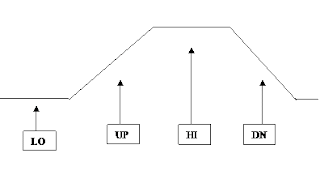
Instead of bits, there are 2 bases of Elements.

I will gladly answer questions by e-mail.
What do you think?
The Signal Generator produces Signal Elements that are conceptually equivalent to bits, but in the elements themselves can be generated in any one of 4 or 8 possible states –referred to as the Quad and the Octo system:

The four states of the Quad system can have the following values that further comprise value methods of computing in U6:
State
|
Symbol
|
Logic value
|
Set
Value
|
Operation value
|
Condition value
|
Set
Value
|
LO
|
o||
|
Not
|
Zero
|
Null (None)
|
except
|
Zero
|
HI
|
^|
|
Yes
|
Unity
|
One
|
Include
|
Unity
|
UP
|
/|
|
Up
|
Fill
|
Set
|
True
|
Fill
|
DN
|
\|
|
Down
|
Empty
|
Reset
|
False
|
Empty
|
The signal generator can also produce this Octo state element system, the octo (octal) system:

whose values are:
Symbol
|
Symbol Value
|
Logic value
|
Set
Value
|
Operation
Value
|
Condition value
| |
LO
|
o=
|
Empty
|
Not
|
Zero
|
accept
|
Except
|
U+
|
{=
|
Common to, not shared
|
share
|
plurality
|
send
|
then
|
U0
|
/=
|
Common to, shared
|
Up
|
Unity
|
compare
|
True
|
U-
|
§=
|
Includes two or more
|
Not equal
|
only
|
exclude
|
when
|
HI
|
^=
|
Excludes
|
Yes
|
Fill
|
Set to
|
Include
|
D+
|
¶=
|
Infinity
|
equal
|
Infinity
|
Take all
|
always
|
D0
|
\=
|
Includes some
|
Down
|
Empty
|
Reset
|
False
|
D
|
}=
|
Includes any one
|
None
|
full
|
Take only
|
if
|
Thursday, July 19, 2007
Intro to the U6- UCICS-The Unified Communication, Information and Computing System
I love working in U6's. It has a fundamental functional environment with an unlimited number of parallel GUIs that incorporates in itself :
- Its memory and the processor have been integrated into one, photonic device based on optical signalling.
- Programming is based on Logic and Symbol equivalent logic code (see U6 languages below)
- An engineering shell for any number of machines invocable from any of the remote, recognized computers
- An SGML-HTML like environment for Internet interface, organically self-written - forget the XML hassles!
- A file and server Protocol Self-Writing facility
 or, in PC terms:
 The Operators!
Forget the CPU. U6 core, if you will, is an operator made up of operators. Imagine a wheel with hub and spokes. Or better yet, the solar system. There is arrays, the central operator, which would remind you of addresses. Everything else is located (figuratively speaking) around the arrays.
The Operators!
Forget the CPU. U6 core, if you will, is an operator made up of operators. Imagine a wheel with hub and spokes. Or better yet, the solar system. There is arrays, the central operator, which would remind you of addresses. Everything else is located (figuratively speaking) around the arrays.
Array Task Manager operator has in itself a group of managers each referred to as When, What, Where, How and How Many managers. The Array Task Manager often is the most crucial component, resembling a kernel in other systems.
Array Definition and Tagging (Addressing) sets up arrays according to the needs of the operation, as well as defines the arrays' discreet dimensions, tags, remembers and searches unique location addresses within all of the arrays.
Search and Iteration set of components conducts all the array searches by any of the value methods, it defines iterations according to search operations. Search and Iteration processors (which are, again, hyper-vector) actively search, find and provide found values, or sets of values, by comparing, matching and other methods that would remind you of hash and range math.
Symbol Processor is the equivalent of a CPU processor, except that it uses all of symbols of any symbol logic it creates for an operation, and uses for operation to calculate processes.
Translators simultaneously translate between different symbol logic systems, value methods, math algorithms, thereby allowing many different machine languages, solid-state PC bit systems and their operating systems to function on a single U6 platform in perfect harmony.
Calculators calculate any math, logic or other value method functions, algorithms and formulas that require result computations and excludes process decision-making (process calculation), which is done by the symbol processor.
Comparators compare entire processes, sets, algorithms, tasks, functions and other activities simultaneously, and substantially faster than your regular Cray or other electronic machines - since sets, algorithms and activities exist as objects relative to the . Unlike the Search and Iteration operator that reaches into locations to search and find, the Comparators receive sets of activities to be compared in decision making.
Programming and Logic later. Isn't U6 cool?
Subscribe to:
Posts (Atom)